When a bike cannot be ridden safely, professional motorcycle towing must do more than move it from one address to another. The motorcycle must remain upright, resist movement in several directions, and be secured without placing straps against vulnerable controls or bodywork. A carefully planned multi-point tie-down system addresses those needs.
The objective is controlled stability, not simply pulling the motorcycle down as tightly as possible. The operator considers the bike’s design, condition, approved attachment areas, wheel support, loading angle, and the route before the truck moves.
Why flatbeds are well suited to motorcycle transport
A flatbed provides a stable platform on which the entire motorcycle can be carried. The bike is loaded onto the deck, positioned upright, and secured before transport. This avoids rolling the motorcycle on one wheel behind a tow vehicle and allows the operator to manage wheel position, clearance, and tie-down geometry together. For these reasons, flatbed towing is often well suited to motorcycles that cannot be ridden safely.
Manufacturer guidance can vary by model. Honda owner guidance, for example, recommends carrying a motorcycle on a trailer or a truck or trailer with a flatbed area and using motorcycle tie-down straps. The motorcycle owner’s manual remains the first reference for model-specific transport instructions.
What multi-point tie-down means
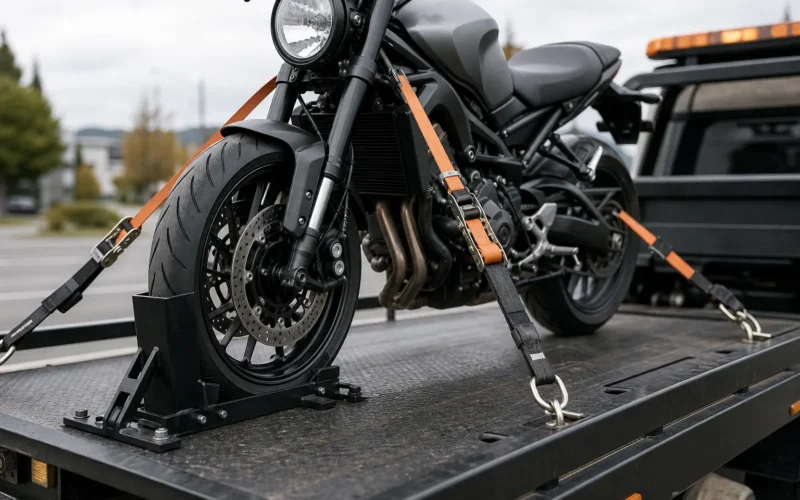
A multi-point setup uses separate, balanced restraints rather than asking one strap or one attachment area to control every direction of movement. Front restraints help hold the motorcycle upright and resist side-to-side movement. Rear restraints help limit lateral shift and keep the back of the bike from stepping out during braking, turns, or road vibration.
The exact number and placement of straps depend on the motorcycle and the equipment. The important principle is that each restraint has a defined job and connects to a suitable structural point without bearing on fragile panels, cables, wiring, brake lines, or sharp edges.
The role of a wheel chock
A properly matched wheel chock supports the front wheel and helps establish the bike’s upright position on the deck. It works with the tie-down system; it does not replace it. Harley-Davidson’s wheel-chock guidance likewise states that a chock is not intended to hold a motorcycle in place during transport without suitable tie-downs.
How a professional securement process works
- Assess the motorcycle.
The operator checks the bike type, weight, condition, steering, tyres, ground clearance, accessories, and any manufacturer transport instructions. - Plan the loading path.
The flatbed angle and approach are considered so low bodywork, exhaust components, or the side stand do not contact the deck. - Position and support the bike.
The motorcycle is placed upright with the front wheel aligned and supported by the appropriate wheel-control equipment. - Choose safe attachment points.
Straps are routed to suitable structural areas, clear of painted panels, controls, hoses, wiring, and sharp edges. - Balance the restraints.
Front and rear points are tensioned progressively and evenly so the motorcycle is stable without unnecessary suspension compression. - Complete a final check.
The operator checks strap seating, loose ends, wheel position, clearances, and overall stability before transport.
Why more tension is not always safer
Over-tightening can place avoidable load on fork seals, handlebar mounts, suspension components, or attachment points. Harley-Davidson advises using the owner’s manual and tightening only enough to create a stable setup; Honda guidance for some models similarly warns that excessive suspension compression is unnecessary.
A sound setup comes from appropriate equipment, sound anchor points, balanced strap angles, and a final inspection – not brute force.
Different motorcycles need different handling
- Cruisers may have substantial weight, wide handlebars, low exhausts, and accessories that affect loading and strap routing.
- Sport bikes often have fairings and compact bodywork that require careful clearance around straps and attachment points.
- Touring motorcycles may carry windscreens, luggage, audio equipment, and other accessories that should not be used as restraint points.
- Adventure, dual-sport, and off-road bikes may have longer suspension travel and model-specific guidance for how much compression is appropriate.
- Electric motorcycles require the same attention to stable transport plus care around charging hardware, battery areas, and manufacturer instructions.
When professional motorcycle towing makes sense
Professional transport is useful after a breakdown, flat tyre, collision, or mechanical problem, as well as for planned delivery to a repair shop, dealership, storage location, or event. It is particularly valuable when the motorcycle cannot be ridden safely or when the owner does not have a suitable ramp, wheel chock, rated restraints, and transport vehicle.
Information to share when booking
- Motorcycle make, model, approximate weight, and condition
- Pickup location, destination, and any access or clearance limits
- Whether the bike rolls, steers, and can be placed in neutral
- Collision damage, fluid leaks, locked steering, or damaged wheels
- Large windscreens, panniers, custom paint, lowered suspension, or other modifications
Frequently asked questions
Is a flatbed always required for motorcycle towing?
The correct transport method depends on the motorcycle, its condition, and available equipment. A flatbed is often selected because it carries the entire bike on a stable deck and supports a controlled multi-point securement setup.
How many tie-down straps should be used?
There is no universal number for every motorcycle. The operator should follow the bike’s manufacturer guidance and use enough correctly placed restraints to control front, rear, and lateral movement.
Should straps be attached to the handlebars?
Not automatically. Suitable attachment points vary by motorcycle, and some models use lower structural points or approved tie-down brackets to reduce load on handlebar components. The owner’s manual should guide the setup.
Can accessories stay on the motorcycle during transport?
Tell dispatch about windscreens, luggage, covers, or loose accessories. Items that could shift, catch air, interfere with straps, or be damaged may need to be removed or separately secured.
Arrange secure motorcycle transport
Call TowSquad at 604.977.2652 with the motorcycle make and model, its condition, the pickup location, and the destination. Dispatch can confirm the available transport setup and current pricing.