This article provides general information about vehicle towing in British Columbia and is not legal advice.
Towing a disabled car with a rope is not as simple as attaching two vehicles and having someone steer the car being pulled. British Columbia’s Motor Vehicle Act Regulations set requirements for towing connections and specifically prohibit a person from being in or on a motor vehicle while it is being towed.
That rule creates an immediate problem with the common DIY method where one driver pulls the disabled vehicle while a second person sits inside it to steer and brake.
If a vehicle has broken down or cannot be driven safely, the better question is not simply whether a rope is available. The condition of the vehicle, the towing setup, road conditions, and BC regulations all affect how the vehicle should be moved.
Can You Tow a Car With a Rope in BC?
BC regulations do not contain a simple statement saying that every possible use of a rope to move a vehicle is prohibited. Instead, the regulations establish requirements for vehicles being towed on a highway.
Section 7.07 addresses trailer connections and towed vehicles. Among other requirements, the connection must be capable of holding the vehicles together, must be attached to structurally adequate parts of the vehicles, and must include an auxiliary coupling device of sufficient strength. The regulations also restrict the length of the connection and prohibit a towed vehicle from whipping or swerving unreasonably.
Most importantly for passenger vehicles, section 7.07(6) states that a motor vehicle cannot be towed while a person is in or on the vehicle being towed.
That means the familiar method of putting one person in the disabled car to steer and operate the brakes while another vehicle pulls it does not comply with this requirement.
Why the Common Two-Driver Method Is a Problem
Many informal towing instructions assume that the disabled vehicle still needs a driver.
The person in the front vehicle accelerates and controls the towing speed, while the person in the disabled vehicle steers, brakes, and tries to maintain tension between the vehicles.
That is exactly the type of arrangement drivers should not rely on in British Columbia. The regulation prohibiting an occupant in the towed motor vehicle removes a central part of that DIY method.
There are practical concerns as well. A disabled vehicle may have reduced braking or steering assistance. Collision damage may affect its wheels, steering, suspension, or safe attachment points. Mechanical or electrical problems can also prevent the vehicle from operating normally.
These conditions need to be considered before the vehicle is moved.
BC Requirements Go Beyond the Rope or Strap
The material used between the vehicles is only one part of the towing setup.
BC’s regulations address how the vehicles are connected and how the towed vehicle behaves while moving. The connection must hold the vehicles together, attachment points must be structurally adequate, and an auxiliary coupling device is required under the regulation. The connection is generally limited to six metres, and the towed vehicle must substantially follow the path of the towing vehicle rather than whipping or swerving.
A rope or recovery strap between two passenger vehicles should therefore not be treated as automatically equivalent to a compliant vehicle-towing setup.
The vehicle itself also matters. Damage to the steering, wheels, suspension, drivetrain, or attachment areas may change how it can safely be transported.
Recovery and Towing Are Different Jobs
There is an important difference between recovering a stuck vehicle and transporting a disabled vehicle along a road.
A recovery may involve moving a vehicle a limited distance to free it from snow, mud, a ditch, or another position where it cannot move under its own power. Once the vehicle has been recovered, it may still need to be loaded and transported elsewhere.
A similar distinction appears in automotive guidance from CarHub, which describes tow straps as equipment for short pulling situations such as freeing a vehicle from mud or a ditch rather than transporting a vehicle down the road.
This does not mean that every recovery can safely be performed with a rope or strap. The vehicle’s weight, condition, attachment points, position, surrounding traffic, terrain, and available recovery equipment all need to be considered.
What Happens When a Vehicle Breaks Down on a BC Highway?
British Columbia’s Motor Vehicle Act Regulations also address vehicles that become improperly equipped because of a collision or breakdown.
Section 2.02 states that a vehicle in this situation must be removed from the highway or taken to a garage or repair shop by a tow car or another vehicle capable of safely carrying out the movement. The regulation also requires reasonable precautions for the safety of highway traffic.
For a stranded driver, that means the condition of the vehicle should determine the transport method.
When arranging towing, useful information includes:
- the vehicle make and model;
- the exact location;
- whether the vehicle starts;
- whether the wheels roll and steer normally;
- whether the vehicle can enter neutral;
- visible collision or wheel damage;
- restricted access or clearance;
- and the intended destination.
Those details allow the towing company to determine what equipment and loading method are appropriate.
Why a Disabled Vehicle May Need a Different Transport Method
A vehicle that looks simple to move may have complications that are not obvious from outside.
For example, locked or damaged wheels can affect loading. Low-clearance vehicles may require additional consideration when approaching a flatbed. Some electric, hybrid, all-wheel-drive, and specialty vehicles have manufacturer-specific transport instructions.
Collision damage can create additional problems because suspension, steering, bodywork, or normal attachment areas may no longer be in their original condition.
For these reasons, the towing method should be selected for the particular vehicle and situation rather than assuming that one method works for every breakdown.
What About Pulling a Vehicle on Private Property?
The BC provisions discussed above concern vehicles being operated or towed on a highway. A vehicle recovery that takes place entirely on private property is therefore a different situation from transporting a disabled vehicle along a public road.
That does not make every rope or strap recovery appropriate.
A vehicle stuck in mud, snow, a ditch, or another difficult position can place significant load on recovery equipment and attachment points. An unsuitable attachment point or uncontrolled movement can damage the vehicle or create a hazard for people nearby.
If the vehicle requires recovery before it can be transported, tell dispatch how the vehicle is positioned and what is preventing it from moving.
What Should You Do Instead of DIY Rope Towing?
If your vehicle cannot be driven safely, arrange towing or recovery based on its condition and location.
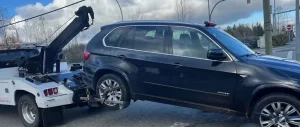
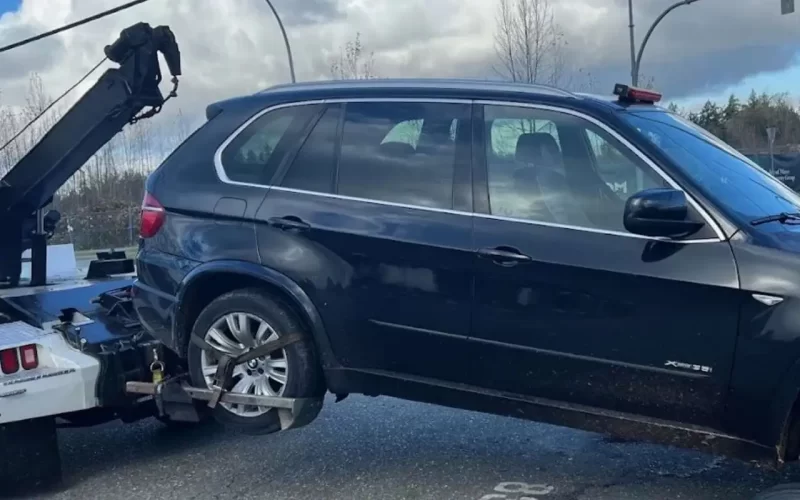
A professional towing operator can assess factors such as vehicle access, wheel condition, ground clearance, steering, drivetrain considerations, and the destination before the vehicle is moved.
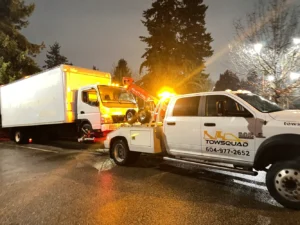
TowSquad provides towing and recovery services across Metro Vancouver for breakdowns, collisions, disabled vehicles, and vehicles that require transport to a repair facility, dealership, residence, or another agreed destination.
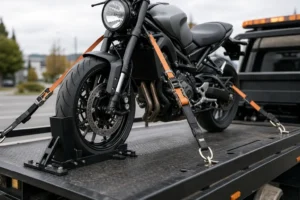
For an urgent breakdown, see our Emergency Towing service or call us at 604.977.2652. Vehicles requiring full-deck transport may also be suitable for Flatbed Towing, depending on the vehicle and situation.
FAQs
Can I tow my friend’s car with my car in BC?
The common arrangement where one person drives the towing vehicle while another person sits in the disabled vehicle to steer and brake conflicts with BC’s rule prohibiting a person from being in or on a motor vehicle while it is being towed. Other requirements for the towing connection also apply.
Can someone sit in the car while it is being towed?
No. Section 7.07(6) of the BC Motor Vehicle Act Regulations prohibits towing a motor vehicle while a person is in or on the vehicle being towed.
Can I use a tow strap to pull a vehicle out of snow or mud?
A short recovery operation is different from transporting a disabled vehicle along a public road. The appropriate recovery method depends on the vehicle, its position, suitable attachment points, and the surrounding conditions.
Is towing a car a short distance with a rope acceptable?
A short distance does not remove the requirements that apply to a vehicle being towed on a highway. The towing connection, vehicle behaviour, and prohibition on occupants in the towed motor vehicle still need to be considered.
What information should I provide when calling for a tow?
Provide the vehicle make and model, exact pickup location, destination, and a description of the problem. Mention collision damage, locked wheels, restricted clearance, steering problems, or a vehicle that cannot enter neutral so the towing setup can be assessed before arrival.
Need to Move a Disabled Vehicle?
If your vehicle has broken down, been involved in a collision, or cannot be driven safely, call TowSquad at 604.977.2652 with your location, vehicle details, condition, and destination.